In 2022, a small independent pharmacy in rural Ohio received a shipment of metformin from a secondary wholesale supplier they had found through a cold sales call. The pricing looked excellent — nearly 30% below what their primary distributor quoted. The DSCSA paperwork arrived with the shipment.
Three months later, during a routine state board inspection, the pharmacist learned that the lot number on the metformin did not match any records in the FDA's serialization database. The supplier had gone dark. The pharmacy was left holding $14,000 in unverifiable inventory and facing a formal inquiry.
The lesson is not that secondary wholesalers are dangerous — thousands of legitimate, compliant secondary distributors operate across the US. The lesson is that a low price and a piece of paper are not the same thing as due diligence.
📌 What This Article Covers
A structured, 5-phase Due Diligence Framework you can apply to every new wholesale medication supplier — including a scoring rubric, specific verification steps with resource links, documented red flags, and a real-world case study of what happens when vetting fails.
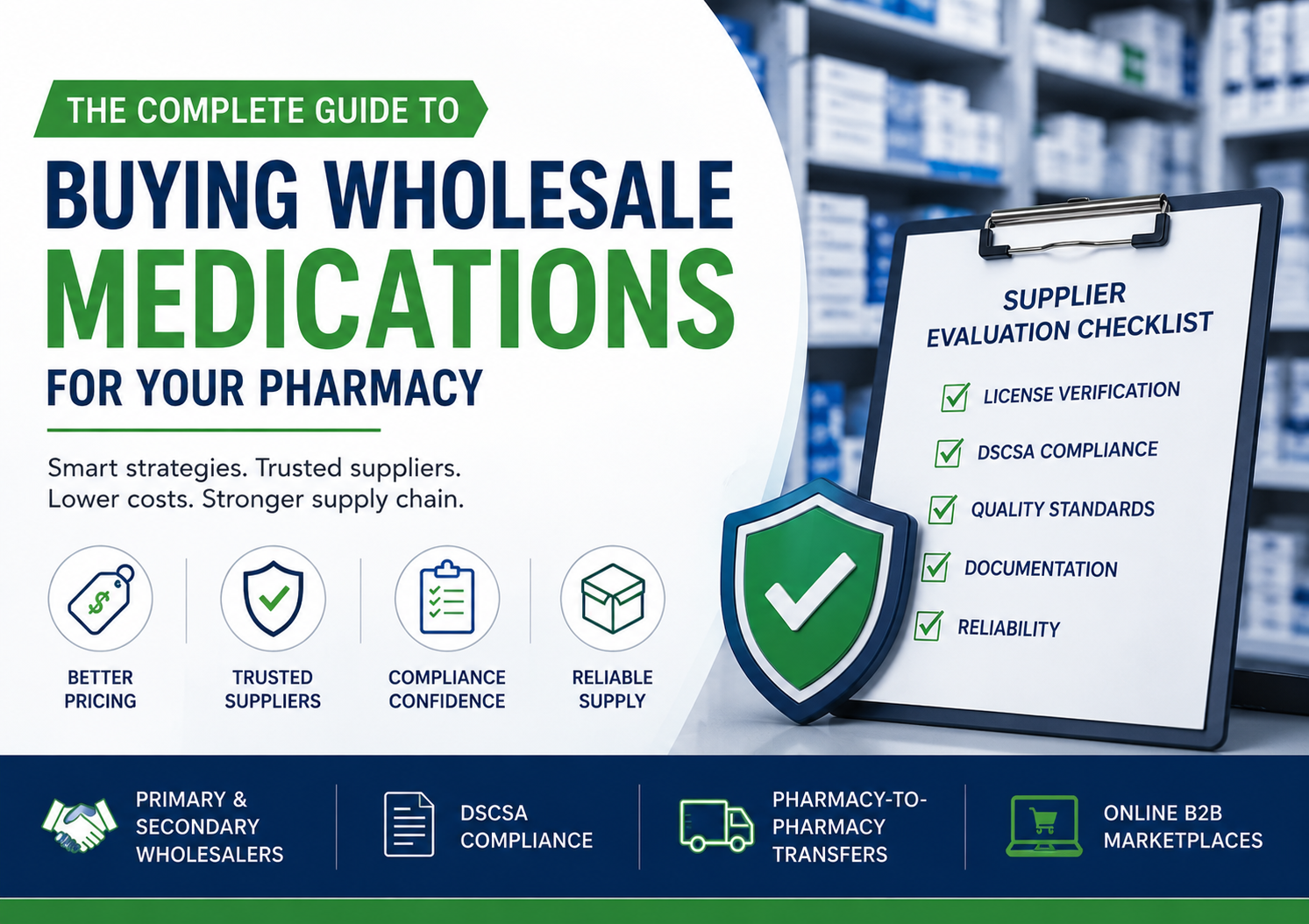
Already familiar with the basics? → Read The Complete Guide to Buying Wholesale Medications for Your Pharmacy for full channel context.
Table of Contents
- Why Supplier Vetting Is More Critical Now Than Ever
- The 5-Phase Due Diligence Framework
- Phase 1: Licensing Verification
- Phase 2: DSCSA Documentation Audit
- Phase 3: Operational & Product Quality Assessment
- Phase 4: Reference Verification
- Phase 5: First-Order Validation
- The Supplier Scorecard
- Ongoing Supplier Monitoring
- Frequently Asked Questions
Why Supplier Vetting Is More Critical Now Than Ever
The pharmaceutical supply chain has never been more complex — or more targeted by bad actors. The FDA's MedWatch program logs hundreds of counterfeit and diverted drug reports annually, and the secondary wholesale market, while predominantly legitimate, presents a higher variance in quality than the Big Three primary distributors.
Since DSCSA's enhanced serialization requirements came into full effect, every licensed pharmaceutical distributor must now be an FDA-authorized trading partner and participate in electronic product tracing. But authorization is not the same as vetting. A supplier can be technically authorized and still deliver inconsistent documentation, near-expiry products without disclosure, or service levels that create operational headaches for your pharmacy.
This complexity is one reason many independent pharmacies are turning to verified marketplace platforms as a starting point for finding new suppliers. When a platform like RxWorld.com requires every seller to hold a current pharmacy or wholesale distributor license before they can list inventory, it does not replace your vetting process — but it does meaningfully narrow the pool you are vetting from. You are starting from verified rather than unknown.
Industry Context
The Scope of the Problem: What FDA Data Tells Us
According to FDA MedWatch reporting, the majority of counterfeit drug interceptions in the US involve the secondary distribution chain — not the primary tier. A 2023 analysis of enforcement actions found that the most common violations by secondary wholesalers were: missing or incomplete DSCSA transaction records (41% of cases), failure to quarantine suspect products (29%), and purchase from unlicensed sources (22%).
Importantly, the pharmacies that accepted these products were often themselves subject to state board actions — even when they had no knowledge of the violation. Ignorance of a supplier's non-compliance does not shield a pharmacy buyer from regulatory consequences.
The implication for independent pharmacies is clear: your vetting process is your first and most important line of defense.
Also Read: Sell pharmaceutical overstock
The 5-Phase Wholesale Supplier Due Diligence Framework
The following framework is structured in sequence — each phase builds on the last. Do not skip phases based on a supplier's reputation or a colleague's recommendation. Independent verification is the standard.
Phase 1: Licensing Verification (Non-Negotiable)
Before any other evaluation, confirm the supplier's legal standing. This takes approximately 20 minutes and should be performed by you directly — not delegated to the supplier's sales representative.
| Verification Check | Where to Check | Pass | Fail |
|---|---|---|---|
| State Wholesale Drug Distributor (WDD) license — active and in good standing | Your state pharmacy board website + the supplier's operating state board | ✅ | ❌ |
| DEA registration (if purchasing controlled substances) | DEA Diversion Control Division online verification tool | ✅ | ❌ |
| FDA Authorized Trading Partner status | FDA.gov → Drug Supply Chain Security Act → Authorized Trading Partners list | ✅ | ❌ |
| NABP Verified-Accredited Wholesale Distributor (VAWD) accreditation | NABP.pharmacy → Accreditation database | ✅ | ❌ |
| No active FDA warning letters or import alerts | FDA.gov → Warning Letters database (search by company name) | ✅ | ❌ |
💡 Pro Insight
How Marketplace Platforms Reduce — But Don't Replace — Phase 1 Work
If you source through a pharmacy marketplace like RxWorld.com, the platform's onboarding process verifies that every seller holds a current pharmacy or wholesale distributor license before they can list. This covers the first row of the table above — active licensure — before you even see a listing.
What the platform does not verify for you: DEA registration for specific substances, VAWD accreditation status, or FDA warning letter history. Those remain your responsibility to check for any seller you transact with. Think of the marketplace's pre-screening as Phase 1, Row 1 — confirmed. Rows 2–5 are still yours to complete.
⚠️ Critical Warning
Licensing Gaps by State
As of 2025, not every state requires secondary wholesale distributors to hold a WDD license in the buyer's state — only in the seller's home state. This creates a gap: a supplier licensed in Nevada can legally ship to your pharmacy in Georgia even if they are not licensed in Georgia.
This does not mean the transaction is illegal. But it does mean your primary licensing check is the supplier's home-state license, not your state's database — a distinction many pharmacists miss during vetting.
Also Read: Short-dated medication risks
Phase 2: DSCSA Documentation Audit
Request a sample documentation package before placing your first order. A legitimate supplier will fulfill this request without hesitation. What you receive — and the quality of what you receive — tells you more than any sales pitch.
Request these specific documents:
- A sample Transaction Information (TI) document — verify it includes: product name, strength, dosage form, container size, number of containers, lot number, expiration date, transaction date, and buyer/seller name and address.
- A sample Transaction History (TH) — this must trace the drug back to the original manufacturer, not just the previous owner. A one-step TH ("we bought it from wholesaler X") is insufficient and non-compliant.
- A sample Transaction Statement (TS) — a signed legal attestation that the product was handled lawfully throughout the chain. Unsigned or undated TSs are a red flag.
- Evidence of serialization capability — they should be able to provide GTINs (Global Trade Item Numbers) and serial numbers for unit-level traceability as required under DSCSA.
Real-World Example
"The One-Page Invoice Test" — How a Chicago Pharmacy Buyer Screens Suppliers in 5 Minutes
A pharmacy buyer at a three-location independent pharmacy group in Chicago developed what she calls the "One-Page Invoice Test" for preliminary supplier screening.
She sends every prospective supplier the same request: "Please send me your DSCSA T3 package for any one transaction from the last 30 days — redact the buyer's name."
The response tells her everything. Suppliers who send a complete TI, TH, and TS within 24 hours, with lot numbers and GTINs included, move to phase 3. Those who send a single-page invoice and call it documentation are immediately disqualified.
"I don't care how good their pricing is," she told a regional pharmacy conference. "If they can't pull compliant documentation in under a day for an existing order, they certainly won't have it ready the day I need to produce records for an FDA audit."
Phase 3: Operational and Product Quality Assessment
Licensing and documentation are necessary but not sufficient. A supplier can be fully licensed and DSCSA-compliant and still be a poor operational partner. Phase 3 assesses reliability, product quality standards, and the specific risks of the products you intend to purchase.
Questions to ask directly:
- What is your average order fulfillment time from confirmed order to shipping? (Acceptable: same-day to next-business-day; concerning: "it depends" without specifics.)
- How do you handle cold-chain medications? What is your temperature monitoring protocol during transit? Can you provide a sample temperature log from a recent cold-chain shipment?
- What is your policy on near-expiry medications? Do you disclose expiration dates at the time of listing or quoting, or only at shipment? (Disclosure at quoting is the standard; disclosure at shipment is a red flag.)
- What is your returns and discrepancy resolution process? What is the average time to resolve a return credit? Do you have a written policy you can share?
- Who are your primary inventory sources? (They may not share specifics, but a willingness to answer in general terms is a positive signal.)
✅ At a Glance
Green Flags vs. Red Flags
GREEN FLAGS: Proactively offers DSCSA sample before you ask. Has written return/discrepancy policy. Discloses expiration dates in quotes and listings — not just on shipping invoices. VAWD accredited. References from pharmacies you can call. Slow to promise, fast to deliver.
RED FLAGS: Pressures you to order quickly before "stock runs out." Cannot provide TH tracing to the manufacturer. Has no written dispute resolution process. Offers pricing that seems implausibly below market. Resists reference calls. Cannot confirm cold-chain capability for refrigerated products.
On platforms like RxWorld.com, sellers are required to include expiration date information in their listings — meaning the green flag of "expiry disclosed upfront" is built into the transaction structure rather than left to the individual seller's discretion.
Phase 4: Reference Verification
A supplier's references are only useful if you actually call them — and ask the right questions. Ask for references from pharmacies that are similar to yours in size, state, and dispensing profile. A reference from a 50-location chain tells you little about how the supplier will treat a single-location independent.
Five questions to ask every reference:
- How long have you been buying from this supplier, and how regularly?
- Have you ever had a DSCSA documentation issue with a shipment? How was it resolved?
- Have you ever received a product that did not match the listing description — wrong lot, wrong expiry, wrong count? What happened?
- Would you trust this supplier for a high-value medication — say, a specialty generic priced at $800 per unit?
- Knowing what you know now, would you onboard this supplier again from scratch?
Question 5 is the most revealing. References who pause before answering — or who give a qualified "probably" rather than an immediate "yes" — have told you something important.
Phase 5: First-Order Validation
Every new supplier relationship should begin with a deliberate test order — a low-value, low-risk purchase specifically designed to observe the supplier's actual performance against their promises.
Designing your test order:
- Choose a high-volume generic you know well — a drug you can immediately verify against your own dispensing records and existing inventory.
- Order a small quantity (one to two bottles) — enough to evaluate the process without material financial exposure.
- Time the order: note when you placed it, when you received a confirmation, when it shipped, and when it arrived.
- Inspect the product against the purchase listing: verify lot number, NDC, expiration date, and unit count.
- Collect and review the T3 documents: cross-reference the lot number against the FDA's Drug Enforcement and Registration database.
- Document every step — this first-order file becomes the baseline against which you evaluate every future transaction with this supplier.
The Supplier Scorecard: A Practical Rating System
Use this scorecard to objectively compare multiple suppliers or track a supplier's performance over time. Score each criterion on a 1–5 scale and total the result.
| Criterion | Weight | Score 1–5 | Weighted Score |
|---|---|---|---|
| Valid WDD license + FDA authorized trading partner | 25% | ___ | ___ |
| DSCSA T3 documentation quality and completeness | 25% | ___ | ___ |
| Expiration date transparency at time of quoting | 15% | ___ | ___ |
| References: pharmacy quality and feedback | 15% | ___ | ___ |
| Cold-chain capability (if applicable) | 10% | ___ | ___ |
| Returns and dispute resolution policy | 10% | ___ | ___ |
| TOTAL | 100% | — | Max: 5.0 |
Interpreting your score:
- 4.5 – 5.0: Strong candidate. Proceed with first-order validation.
- 3.5 – 4.4: Acceptable with conditions. Clarify any weak areas before transacting.
- 2.5 – 3.4: Proceed cautiously. Address gaps before purchasing anything beyond low-value generics.
- Below 2.5: Do not purchase. The risk to your pharmacy's compliance and patient safety is not worth the price advantage.
Vetting Isn't One-Time: Ongoing Supplier Monitoring
A supplier who passes your initial due diligence can deteriorate over time. License renewals lapse. Ownership changes. Quality processes slip. Build a monitoring cadence into your pharmacy operations:
- Quarterly: Re-verify your top five suppliers' license status in their home-state database and FDA authorized trading partner list.
- Semi-annually: Conduct a mini performance review: review order accuracy, documentation quality, pricing consistency, and response times over the prior 6 months.
- Annually: Request updated VAWD accreditation certificates (if applicable) and re-run the supplier scorecard.
- Immediately: Re-vet any supplier following a change in ownership, acquisition, or significant personnel change — ask them directly and re-run Phase 1 verification.
Practical Tip
The "License Expiry Calendar" Trick Used by High-Volume Pharmacy Buyers
One purchasing manager at a regional independent pharmacy group manages relationships with 11 secondary suppliers. Rather than relying on suppliers to notify her of license renewals, she maintains a simple spreadsheet tracking each supplier's WDD license expiration date in their home state.
She sets a calendar reminder 45 days before each expiration date. If a license has not been renewed within 15 days of expiry, she pauses orders with that supplier until renewal is confirmed.
"It has never created a material disruption," she said. "But it has caught two situations where a supplier's license lapsed and they were still taking orders. That's not a supplier I want to be buying from."
Frequently Asked Questions
How long does it take to properly vet a new pharmaceutical wholesale supplier?
A thorough due diligence process — covering all five phases including reference calls — typically takes 3–5 business days. Phase 1 (licensing verification) takes about 20–30 minutes. Phase 2 (documentation audit) depends on how quickly the supplier responds, typically 24–48 hours. Reference calls (Phase 4) require scheduling and can take 2–3 days. Do not compress this process under time pressure — a shortage situation is precisely when bad actors exploit urgency to bypass normal vetting.
Is VAWD accreditation mandatory for a secondary wholesaler?
VAWD accreditation from NABP is not federally mandated, but it is the strongest third-party quality signal available in the secondary wholesale market. Some states require it; others do not. For your purposes, treat VAWD accreditation as a significant positive indicator — it means the supplier has undergone independent audit of their facilities, quality systems, and DSCSA compliance practices. Its absence is not disqualifying, but its presence meaningfully reduces your vetting burden.
What should I do if I discover a supplier I'm already using has a compliance problem?
Stop purchasing from that supplier immediately. Do not return any product — instead, quarantine it separately and contact your state pharmacy board for guidance on how to handle product received from a potentially non-compliant source. Document everything: when you discovered the issue, what the issue was, and every communication with the supplier and regulators. If you have already dispensed product from the suspect lot, consult your pharmacist-in-charge and legal counsel about patient safety obligations.
Can I use a pharmacy B2B marketplace as my primary source for wholesale medications?
A pharmacy B2B marketplace is best used as a supplementary sourcing channel — for spot buying, shortage gap-filling, and accessing overstock inventory at competitive prices — rather than as a replacement for your primary wholesaler relationship. Platforms like RxWorld.com require every seller to be a licensed pharmacy or licensed wholesaler in good standing, which addresses the most common vetting failure point (unlicensed sources). You still need to perform DSCSA documentation review for each transaction, but the pre-verified seller pool materially reduces your exposure to the risks described in this article. Importantly, transactions on RxWorld are intended for specific patient needs or declared public health emergencies — they are not classified as wholesale transactions for general stocking. Factor this into how and when you use the platform.
About RxWorld.com
A verified marketplace for licensed pharmacies and wholesalers
RxWorld.com is an online pharmacy marketplace where licensed independent pharmacies and wholesalers buy and sell unexpired medications. Every seller on the RxWorld platform is a licensed pharmacy or licensed wholesaler — membership requires verification of pharmacy licensure in good standing before access is granted.
For pharmacy buyers, this means the initial licensing check described in Phase 1 of this guide is built into the platform's onboarding process. You still need to perform your own DSCSA documentation review for each transaction, but you are starting from a pool of verified, licensed sellers rather than the open market.
Transactions on RxWorld.com are intended for specific patient needs or declared public health emergencies, and are not classified as wholesale transactions for general inventory stocking. Review your state's regulations and RxWorld's membership terms to understand how the platform fits your pharmacy's purchasing strategy.
Disclaimer: This article is for informational purposes only. Regulatory requirements vary by state and are subject to change. Always consult your state pharmacy board and compliance advisors for current requirements.